
A guide to running a stand at FOSDEM
FOSDEM 2026 was my third year running a stand for Luanti at the world’s largest free and open source conference. In this article, I will share some of the things I learned and what I wish I knew before I ran my first stand.
What is running a stand at FOSDEM like? #
The atmosphere at FOSDEM is amazing. It’s full of passionate people who work with and use open-source software. It’s incredible how these events bring open source projects and communities together. For an open source project, the stand becomes the centre of the project for the weekend, with so many people who have worked together for years online finally meeting in person.
FOSDEM is very busy, especially on Saturday. At peak times, there will be a sea of people in front of the stand. Many of the stands are in corridors outside of talks, so it can get crowded. Some stands are in lobbies, which provides more space.
FOSDEM is 17 hours of talking to people. It’s a lot and you’ll sleep well when it’s done (assuming you don’t drink too much Belgian beer!).
Half of the work of running a stand is before the FOSDEM weekend. Running a stand can take months of planning, especially if you need to create resources and demos.
Check out Luanti’s FOSDEM 2026 post for more information about Luanti’s stand at FOSDEM, including what we discussed with visitors.
What should I have on my stand? #
Stuff on your stand can be placed into three categories: what draws visitors in, what demos, information, or talking aids to use whilst they are there, and what they can take away.
To draw visitors in #
FOSDEM is an incredibly busy event. You’ll most likely be in a hallway with a crowd of people moving past. It’s often hard to see a stand over the crowd, so you’ll need a roller banner so people can spot you. The top of the banner is the most important; it should contain the project’s name and some indication of what it’s about. Simplicity is key with the roller banner, as it’ll need to be read from a distance quickly.
To see whilst they’re there #
Whilst at your stand, visitors will want to find out what your project is about and maybe give it a go.
If relevant for your project, it’s good to have a couple of demos available. The average visitor time is a few minutes, so make sure they can get a good feel for your project in that time. For example, on the Luanti stand we found that the default Luanti menu was a poor experience under time constraints. We created a specialised demo mode that allowed visitors to start playing with a single click.
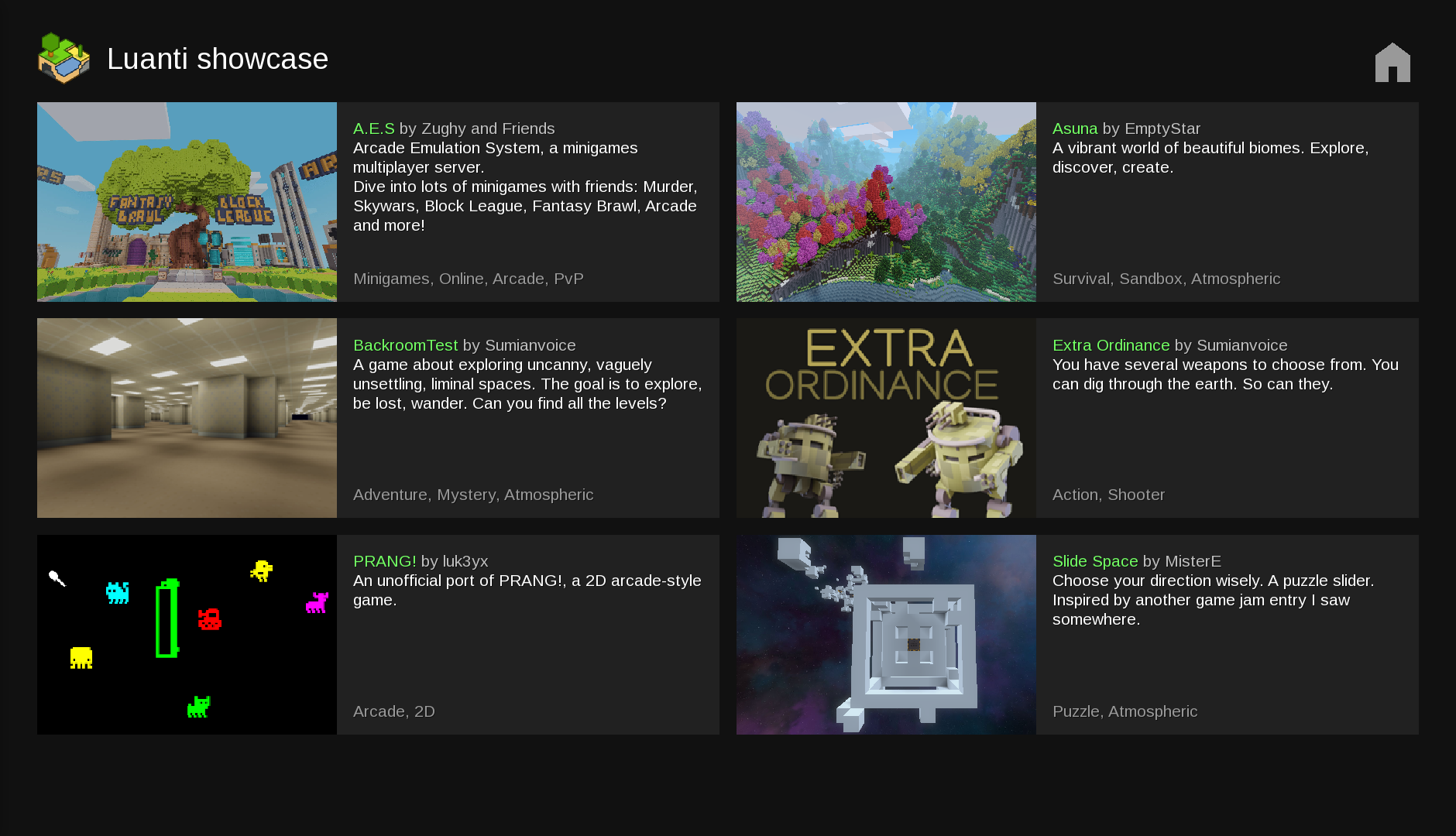
Try to anticipate what the most common questions are as you’ll hear them hundreds of times and it’s nice to have a talking aid. At the Luanti stand, we got a lot of questions about educational uses and so we were glad we brought an education flyer.
If you include a QR code, make sure to also include a short URL. Many people, even at FOSDEM, have problems scanning QR codes.
To take away #
A flyer or folded leaflet acts as a reminder for the visitors to look up your project later. A good size is A5 or A6. Most visitors will understand English, but they will be very thankful if you provide materials in other languages. The most popular other languages are French and German. Luanti gave away roughly 300 English flyers and an unknown number in four other languages (FR, DE, IT, ES).
FOSDEM visitors love stickers. This year, Luanti gave away 2,000 stickers including 300 Lua stickers. The number of stickers you need depends on how popular your project is (and how cute the sticker is!) but I’d recommend getting several thousand. Stickers are relatively cheap and compact and if they don’t go you can use them another year. The most common size for stickers is between 4x4cm and 5x5cm. Larger stickers are more expensive and you can’t fit as many of them on a laptop!
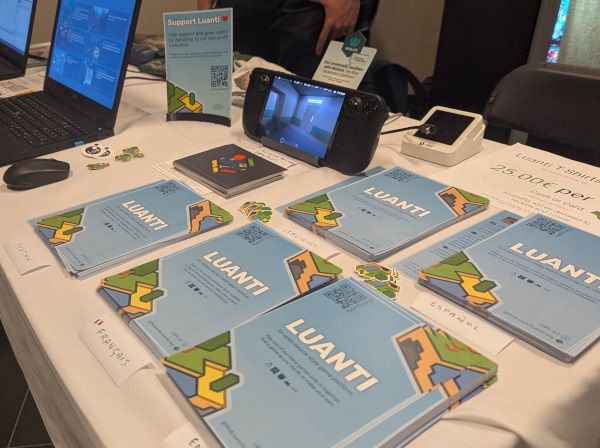
Other handy things to bring #
- EU power strip. Whilst most tables do get their own strip, you may be sharing a strip with a neighbouring table.
- Sticky labels/painters tape and sharpies for quick signage. Please note that you are not allowed to attach things to the walls behind the stand.
- Tape and zip ties for making cables safe.
- Packed lunch. The queues in the food area can get very long during lunchtime.
Logistics #
Getting things there #
FOSDEM doesn’t have the ability to accept deliveries, so you’ll need to bring any materials with you. Your hotel may be able to accept deliveries but this is rare, in my experience, for the cheaper hotels.
People #
I recommend having at least two people on your stand at any one time, to avoid too much being placed on one person. This means you should have at least three people on your stand team. More than three people would give your staff more time to take breaks and explore the conference.
Some stands use a rota to ensure the stand is adequately staffed and allow people to have time to experience FOSDEM. We did things fairly ad hoc and didn’t use a rota, but we’re considering doing one next year. I’d like to make sure I take more breaks next year and actually go see some talks.
It can be hard to find people to run the stand with if you only know people online. I put a call out into the community to find people interested in running the stand; it took a few years. It’s handy to have a multilingual stand team, especially covering English, French, and German.
Accommodation #
For the first two years, we booked AirBnBs but found the quality and experience to be pretty lackluster. If you book in advance, sharing twin rooms in a hotel can be around the same price. In fact, the hotel for 2026 was cheaper than our AirBnBs in 2024 and 2025!
I recommend getting somewhere in Louise. It’s walking distance to the university and is a lovely area.
What else? #
FOSDEM is a great opportunity to bring your community together and connect with other projects. Friday and Saturday nights are the most social nights. Many people leave on Sunday evening and you’ll likely be very tired anyway.
On Saturday night, ten members of the Luanti community got together for pizza. Bringing people together is hugely beneficial; after the meal, we spent hours discussing how to improve the project’s governance and development.
Submitting a talk or workshop can be very rewarding; just make sure you have enough people on your stand team - both at the event and doing the planning.
How much did it cost? #
This is highly variable based on what and how much you bring. Based on the Luanti numbers, here’s how much it might cost:
- 600 € for accommodation (for 4, 2x twin rooms)
- 300 € for travel (for 4)
- 500 € for print materials
- 260 € for 2k stickers
- 180 € for flyers
- 60 € for a roller banner
Which is a total of €1,400.
You’ll want to book hotels and travel as soon as possible, as it can save you a lot of money. Black Friday is not long after the stands are typically announced and many hotels offer deals.
Conclusion #
Running a stand at FOSDEM is a lot of work but also a lot of fun and I’d highly recommend giving it a go.
I’d like this to be a resource for new standholders. Feel free to ask questions in the comments. If you’ve run a stand before and have any further tips, feel free to leave a comment and share your experience!
Comments
If I could add just one thing, it would be “and wear a decent mask; pack a spare / replacement filter”. Air flow was dreadful, and it was rammed with people.